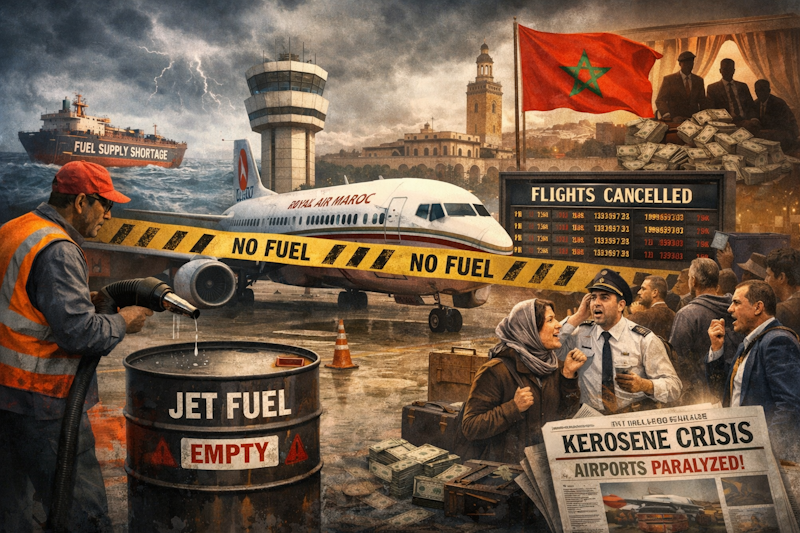
Morocco continues its slide into greater confusion and disorder after a severe kerosene crisis paralyzed its airports—airports that the regime has long promoted as symbols of “modernization” and “openness.” Airlines found themselves forced to land at Moroccan airports with tanks full to the brim, avoiding refueling inside the country, a situation reflecting the fragility of a system that is supposed to be a cornerstone of logistical sovereignty.
The General Directorate of Civil Aviation issued clear instructions to airlines to fill aircraft with enough fuel before takeoff: the maximum for long-haul flights, and enough for round trips for short and medium flights—an exceptional measure highlighting the depth of the crisis. According to a report by the site 360 on Monday, this crisis, according to the official narrative, stems from heavy rains and floods described as “exceptional,” which forced the evacuation of more than 100,000 people in northern Morocco.
However, what these climate-based explanations conceal is a darker reality. Behind the curtain of “emergency conditions” emerges the true face of the regime: structural fragility, chronic mismanagement, and corruption gnawing at the state’s foundations. The ports, which are supposed to receive fuel tankers, have stalled, leading to shortages in petroleum supply in a country entirely dependent on imports to meet its energy needs.
Even more alarming is the absence of any real strategic reserves. As of February 5, reserves did not exceed 617,000 tons—equivalent to only 20 days of consumption—a meager figure compared to the 11.7 million tons consumed in 2022, according to official figures. Is this a matter of poor estimation? Or a complete collapse of a management system in which public funds are wasted in networks of patronage and cronyism tied to energy barons and power centers close to the palace?
This crisis is not an isolated incident but a natural consequence of a system built on corruption and clientelism. While the regime showcases its giant projects, from Tangier-Med to Dakhla Atlantic, vital reserves remain at their lowest levels. The floods did not create the crisis—they exposed the fragility of a system that prioritizes serving its elite over ensuring the basic elements of stability.
Questions are mounting about the fate of fuel shipments: do they really reach their destination, or are they diverted to undisclosed channels serving the interests of the powerful? This crisis has revealed the Moroccan system’s vulnerability to exposure at the first real test, amid a lack of planning, reliance on improvisation, and dominance of bribery over sound governance.
Thus, Morocco pays the price for a system skilled only in repression and the distribution of privileges, while the foundations of energy security crumble, leaving citizens and the economy hostage to the regime’s inability to manage its crises.
#Morocco #Fuel #Aircrafts #Flights
Soyez le premier à commenter