


US Israel war against Iran Strait of Hormuz tanker
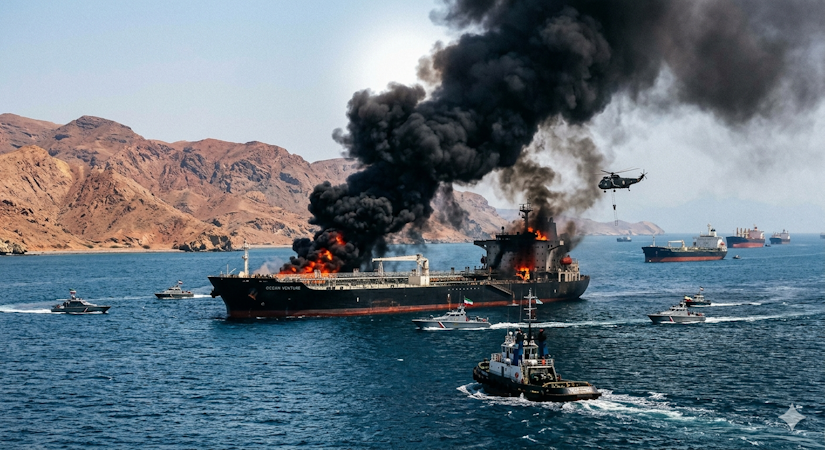
Jerusalem/Washington – March 31 — The conflict in the Middle East has reached a new critical threshold. An oil tanker loaded with crude was attacked and set ablaze Tuesday off the coast of Dubai, in an operation attributed to Iran, despite repeated warnings from U.S. President Donald Trump.
According to Dubai authorities, the Kuwait-flagged vessel Al-Salmi was struck in a drone attack while carrying nearly two million barrels of oil. The fire was brought under control without casualties or any oil spill, though the ship’s hull sustained damage. The tanker was en route to the Chinese city of Qingdao.
Attack in a Strategic Strait
The incident occurred in the Strait of Hormuz, a critical waterway through which roughly one-fifth of the world’s oil and liquefied natural gas supplies transit. In recent weeks, the area has seen repeated attacks on commercial vessels amid a broader military escalation involving Iran, the United States, and their allies.
Iran’s Revolutionary Guards claimed they were targeting a different vessel linked to Israel, the Haiphong Express, suggesting the tanker hit may not have been the intended target.
Fears of a Global Oil Shock
The attack immediately rattled markets. Crude oil prices surged again, extending a dramatic rise of more than 50% since the start of the month. Brent crude now trades above $113 per barrel, fueling concerns over a global energy crisis.
In the United States, the impact is already being felt: the national average gasoline price has exceeded $4 per gallon for the first time in over three years, putting pressure on households and on the Trump administration ahead of midterm elections.
Urgent Diplomacy, Ongoing Threats
As the situation deteriorates rapidly, several international actors are attempting to contain the escalation. China, the largest importer of Iranian oil, has called for immediate de-escalation, while Pakistan is stepping up mediation efforts.
But tensions remain high. Donald Trump warned that the United States could strike Iranian energy infrastructure, including Kharg Island, if Tehran refuses a deal and does not reopen the Strait of Hormuz.
For its part, Iran has dismissed U.S. proposals as “unrealistic” and continues its military operations across the region.
A Widening Regional Conflict
The conflict has now spread far beyond its initial scope. Houthi rebels in Yemen, Hezbollah in Lebanon, and several regional states are increasingly involved in intensifying clashes. Missiles, drones, and strikes have been reported in Israel, Saudi Arabia, Turkey, and within Iran itself.
Meanwhile, thousands of U.S. troops, including units from the 82nd Airborne Division, have been deployed to the Middle East, raising speculation about a possible ground intervention.
As Washington’s deadline for a deal approaches, the international community now fears a prolonged disruption to global energy markets—and a military escalation with unpredictable consequences.