


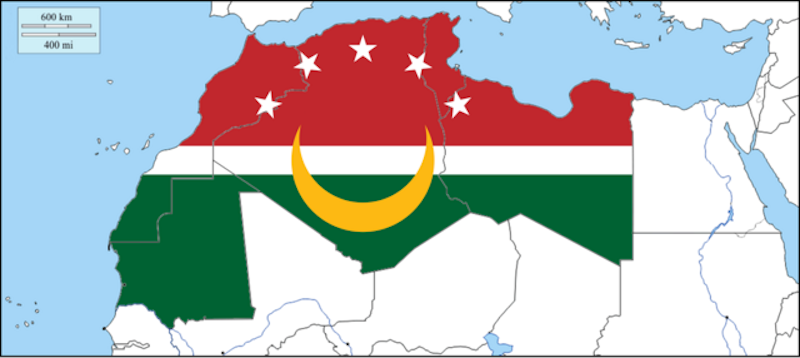
According to the University of Navarra, despite repeated efforts at regional cooperation, the Maghreb remains far from realizing its potential as a regional powerhouse. The Arab Maghreb Union (UMA), conceived as a platform for economic and political integration, continues to lag behind other African blocs. Yet, with abundant natural resources, a strategic geopolitical position, and a population approaching 100 million, the region represents a “could-have-been” hub of influence.
Analysts suggest that uniting the Maghreb could create a combined GDP exceeding $360 billion—comparable to nations such as South Africa, the UAE, or Norway, according to a 2019 IMF study. But decades of tension, particularly between Algeria and Morocco, have turned the UMA into what some political scientists call “a total failure,” limiting development and curbing the region’s international clout.
Colonial Legacies and Diverging Paths
A closer look at history helps explain why cooperation has been so difficult. While one might assume that a shared struggle against French colonialism would foster unity, the reality is strikingly different. Algeria, Morocco, and Tunisia experienced French rule in radically different ways, shaping distinct political structures and post-colonial identities.
Algeria endured the longest and most direct French control, incorporated into France as three departments—Algiers, Oran, and Constantine. Its independence came only after a brutal war, leaving deep social scars, authoritarian governance, and a nationalized economy. Morocco and Tunisia, by contrast, were protectorates that retained significant autonomy: Morocco preserved the traditional makhzen system under the monarchy, while Tunisia maintained a degree of governmental independence and cultural continuity.
These divergent colonial experiences fostered mistrust and set the stage for post-independence rivalries. Territorial disputes, particularly the Sand War of 1963, stem directly from administrative borders imposed by France. For Moroccans, these borders remain a symbol of “unfinished decolonization,” while Algerians see them as a testament to the sacrifices of their liberation struggle. Over time, this has fueled recurring tensions, including the unresolved Western Sahara dispute.
The Western Sahara Factor
The Western Sahara remains a core point of contention. Morocco claims the territory as part of its kingdom, while Algeria supports the Sahrawi people’s right to self-determination. The dispute has frozen trade, closed borders, and diverted both countries’ attention toward external partners rather than regional cooperation. In 2021, for example, Algeria halted gas exports to Spain via Morocco, illustrating how political rivalries directly undermine economic opportunities.
The ongoing tension reflects a classic security dilemma: each country invests heavily in defense to maintain a perceived advantage over the other. In 2024, Algeria’s military spending reached $18.3 billion (7.2% of GDP), while Morocco spent $13.4 billion (4.2% of GDP). Together, they account for nearly 87% of North Africa’s military expenditure. Such a focus on security diverts resources from health, education, and infrastructure—critical pillars for socio-economic development.
Economic and Social Costs
IMF projections suggest that greater trade openness, integration into global value chains, and export diversification could raise incomes in the Maghreb by 5–10% over the next decade. Yet, these potential gains are sacrificed in favor of entrenched hostilities. Socially, the region is far from divided: shared languages, cuisines, and cultural practices, along with dense cross-border ties, indicate that political barriers—not societal rifts—prevent integration.
Toward Détente
Experts argue that progress is possible through incremental confidence-building measures: easing trade restrictions, facilitating cross-border mobility, and demonstrating the mutual benefits of cooperation. While such steps do not resolve the Western Sahara issue, they could lay the groundwork for dialogue and trust. International actors could also play a role, by supporting UN initiatives or subtly restricting arms transfers to reduce tensions.
Algeria and Morocco, with their combined resources, populations, and military influence, remain indispensable to the Maghreb’s potential. But meaningful regional integration requires at least a minimal level of détente. Without it, the region will continue to be a “should matter but does not,” its potential as a regional power undermined by historical grievances, unresolved disputes, and a persistent focus on security.
#Maghreb #UMA #Algeria #Morocco #WesternSahara